

Prosecution and judgment of cases involving foreigners
Legal basis
- The 1963 Vienna Convention on Consular Relations
- Ordinance on Privileges and Immunity for Foreign Diplomatic Agencies, Consular Agencies and Representative Agencies of International Organizations in Vietnam dated March 28, 1993.
- The civil code, the criminal code and the criminal proceedings code of Vietnam.
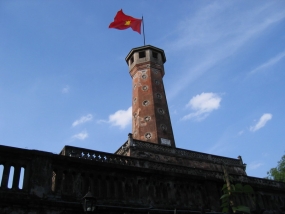
Hanoi Flag Tower at the age of nearly 200 years is renowned as one of the symbols of Hanoi. The construction began in 1805 and completed in 1812, the 11th year of Gia Long time, Nguyen dynasty, five years after construction time of Flag Tower in Hue.
Hanoi Flag Tower is 33m height with three platforms and the eight-side tower, and 41m height consisting of the flag pole. With original construction purpose as an observatory; Hanoi Flag Tower offers a breathtaking view for the watchers standing on it. The top of the tower is an eight-side room with eight windows corresponding to eight directions, offering enough space for six people standing inside. “Ngenh huc” means “Welcome dawn’s sunlight”, “Hoi quang” means “Reflecting the light”, and “Huong minh” means “Direct to the light” are alternately inscribed on the eastern, western and southern door of the tower. At the northern door, there are two stairs in the left and the right hand side.
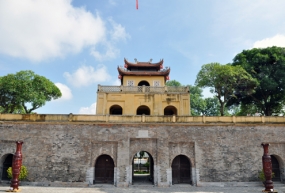
History revealed that Imperial Citadel of Thang Long changed a lot but its centre, especially Forbidden City, remained nearly unchanged. As architectural structures inside the Imperial Citadel were rebuilt and upgraded several times, this explained for the findings of layers of architectural vestiges and artefacts at archaeological site at 18 Hoang Dieu.
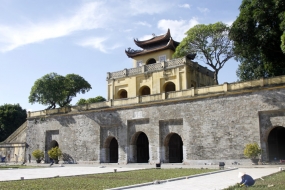
The main part of Imperial Citadel of Thang Long – Hanoi essentially covers a large area of 20 ha consisting archaeological area at 18 Hoang Dieu Street and relics in Hanoi Citadel such as: Bac Mon, Doan Mon, Hau Lau, stone dragons in Kinh Thien Palace, dragon house, house D67 and Ha Noi flag tower. These relics are surrounded by 4 streets: Phan Dinh Phung Street in the north, Dien Bien Phu Street in the south, Nguyen Tri Phuong Street in the east and Hoang Dieu Street in the west.
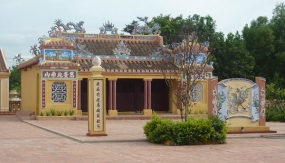
Location: Nai Nam Communal House lies in Dang Luu street, group 11 Nam Son, Hoa Cuong Ward, Hai Chau district, Da Nang City.
Characteristic: It was constructed in the year of At Ty (1905) to venerate the village protective god of safety and fairness, the residential gods of the earth and the village forefathers.
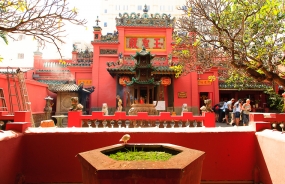
Location : 73 Mai Thi Luu Street, district 1, Ho Chi Minh City, Vietnam
Built in 1909 by the Cantonese immigrants, Jade Emperor Pagoda or Chua Ngoc Hoang or Phuoc Hai Tu is one the most attractive destinations for tourist in Ho Chi Minh City. It is also known as the Tortoise pagoda.
